Low MOQ Guides
Tennis Wear MOQ and Fabric: What New Brands Get Wrong
Starting a tennis line? Here is what 100 pieces per style per colour really buys, which fabrics hold up on court, and the skort mistakes new brands make.
A tennis line fails before it starts when a new brand orders the wrong quantity in the wrong fabric. The short answer is this: a fully custom tennis style starts at 100 to 150 pieces per style per colour, with sizes mixed inside that number, and a ready-stock style with your logo added starts at 20 pieces. A sample costs 50 US dollars per piece and takes 10 to 15 days to make; bulk production takes 25 to 35 days after you approve the sample. For fabric, start from two proven options: 78 percent nylon and 22 percent spandex at 230 grams per square metre, or 85 percent nylon and 15 percent spandex at 170 grams per square metre. And a skort is two garments in one: an outer skirt and inner shorts that must be shorter than the skirt and must not show. This article is for a new brand planning its first tennis collection and deciding what to order and what to make it from. It is not for a brand that only needs a price on a style it has already sampled, because the bulk price and the shipping price are both quoted for each order and are not fixed in this article.
You ordered 100 pieces, but in how many colours?
The first mistake new tennis brands make is counting the minimum order the wrong way. They hear 100 pieces and plan a launch of 100 pieces in total: one skort in three colours, a dress in two colours, a polo in black and white. That is not how the minimum works. The minimum is 100 to 150 pieces per style per colour, so one skort in three colours is three separate minimums, and the smallest fully custom order for that one skort is 300 to 450 pieces, not 100. A brand that plans its launch on the total count discovers the real number only when the quote comes back, and by then the budget and the launch date are both wrong.
The fix is to plan by style and colour, not by collection. Pick one style and one colour first, and count 100 to 150 pieces for that single combination. Sizes are mixed inside that quantity, so you can split those 100 pieces across your size range instead of ordering 100 pieces of one size. That is how a small brand starts: one skort in one colour, sizes mixed, 100 pieces. Add a second colour only when the first one is selling, because each new colour restarts the minimum. Some styles need 150 pieces rather than 100, and the final minimum depends on the fabric, the colour, and the customisation, so confirm the number for your exact style first.
There is a second road into tennis wear, and it suits a brand that is not ready for 100 pieces of one colour. A ready-stock style with your logo added starts at 20 pieces per style per colour, so you can put your brand on a tennis dress or a skort that already exists and test it with a small order. The trade is clear: you get a lower minimum and a faster start, but you give up the custom fit, the custom fabric, and the custom details that a fully custom order gives you. New brands get this choice wrong in both directions. Some order a fully custom skort when a ready-stock style would have tested the market for a fifth of the quantity. Others order a ready-stock dress, then discover that the pleats and pocket they want make it a fully custom order with a fully custom minimum. Decide which road you are on before you ask for a price, because the price, the minimum, and the timeline all change with the road.
A yoga fabric is not automatically a tennis fabric
The second mistake is choosing the fabric by how it feels in the hand instead of how it behaves on court. A tennis player serves, lunges, bends low for a drop shot, and twists at the waist on every rally. The fabric has to stretch in every direction, come back to its shape after every point, and stay opaque when the player bends and when the fabric is pulled tight. A fabric that feels soft and light on a hanger can still go sheer across the seat of a skort, or lose its recovery after a few hard matches, and neither problem shows up until the garment is worn and washed.
Start from fabrics that are already proven on activewear, and let the sample confirm the choice. The first option is 78 percent nylon and 22 percent spandex at 230 grams per square metre. It is the heavier of the two, with a smooth, buttery hand feel, four-way stretch, and enough body that it does not go see-through when it is stretched. It suits a skort, a tennis dress, and any style where coverage matters more than lightness. The second option is 85 percent nylon and 15 percent spandex at 170 grams per square metre. It is lighter, it suits a polo or a top where the player wants less weight, and it still stretches in four directions. Pick the job first, then the fabric: the heavier fabric holds its shape and covers, and the lighter fabric moves with less weight.
Do not choose a tennis fabric from a photograph or a description alone. Order a sample in the fabric you are considering, in your colour, and test it the way a player would. Stretch it hard across the seat and the thigh and look at it against the light. Move in it, bend in it, and wash it once in cold water, then check whether it kept its shape and its colour. A sample costs 50 US dollars per piece and takes 10 to 15 days, and that one sample answers the question a photograph cannot: does this fabric hold up on court, or does it only look right on a hanger. If you are choosing between the two fabrics above, make one sample in each and compare them on the body, not on the desk.
The skort only works when the shorts underneath work
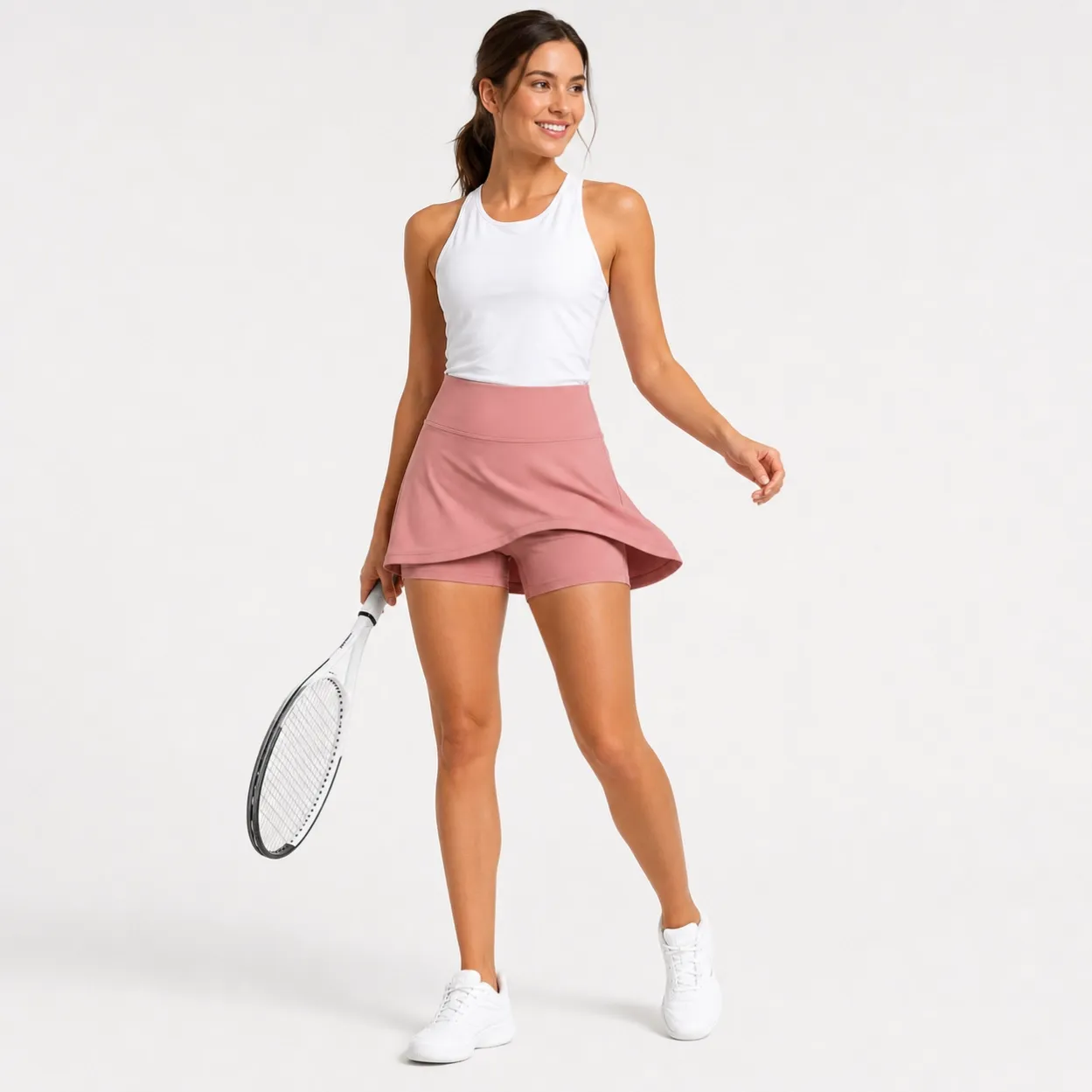
The third mistake is treating a skort as a skirt. A skort is two garments sewn into one: an outer skirt, usually a half skirt or a pleated skirt, and inner shorts underneath it. The construction rule is simple and easy to get wrong: the inner shorts must be shorter than the outer skirt, so they never show below the hem, and they must stay hidden while the player moves, serves, and sits on a changeover bench. When the inner layer is too long, it peeks out below the skirt and the garment looks unfinished. When it is too short, it rides up and the player spends the match adjusting it instead of playing. When the two layers do not match in stretch, the skirt pulls one way and the shorts pull the other, and the whole garment twists.
Get the details of the inner layer right in the tech pack before the sample is made. Write down the length of the inner shorts against the length of the outer skirt, and write down whether the inner layer has a pocket, because a ball pocket is one of the features buyers ask about first on a tennis skort, and it changes the pattern and the price. Say which fabric each layer uses, because the two layers do not have to be the same: one skort style we make uses 90 percent recycled nylon and 10 percent spandex for the outer skirt, while the inner shorts use a lighter stretch fabric. Say how the skirt is finished, whether it is pleated or plain, and say where the logo goes, with its size as a number and its position as a place on the garment. A silicone logo has a one-time mould fee of 35 to 40 US dollars per design, charged once and not per piece, and the factory can only confirm it when it knows the size, the position, and the method.
Check the skort on a moving body, not on a hanger. When the sample arrives, try it on, sit in it, bend in it, and walk in it, and look at it from behind, because the back is where a too-long inner layer and a twisting seam show first. Photograph anything that looks wrong and send the note to the factory in writing, with the measurement that needs to change, because a factory can only fix what you name.
The sample is where tennis wear is really tested
The fourth mistake is treating the sample as a formality. A sample is not a smaller version of the bulk order. It is the one chance to find out, before 100 pieces are cut, whether the style, the fabric, and the fit actually work. The process runs in three steps, and each step has a time you can plan around. First, the factory makes your sample: 50 US dollars per piece, 10 to 15 days after your design and logo are confirmed. Second, you check the sample and confirm it, or you ask for the changes you need. Third, the factory makes your bulk order, which takes 25 to 35 days after you approve the sample, and a fully custom order starts at 100 to 150 pieces per style per colour, with sizes mixed inside that quantity.
Test the sample the way your customer will use it. For a tennis dress or skort, that means moving in it, not just standing in it. Serve in it, lunge in it, bend low in it, and sit in it. Check the measurements against your size chart, and check the logo size and position against your tech pack. Check the fabric by stretching it, and wash the sample once in cold water, then check whether the colour held and the shape came back. Check the seams where the skirt meets the shorts, and check the pocket if your style has one, because a pocket that is too shallow drops the ball on the first run. Write down what passed and what failed, with a photograph of each problem, and send that note to the factory in writing.
A sample that fails is not a wasted 50 dollars. It is the cheapest lesson in the whole order, because a bulk order that fails costs the whole order and the whole season. Pay for the sample, test it hard, and only then approve the bulk.
Your next step: send one style, one colour, one sample first
You do not need a full collection to start a tennis line. You need one style, one colour, and one sample that proves the idea. Open our Custom Tennis Dresses and Skorts page and pick the style closest to what you have in mind, a skort, a dress, or a set. Then send us the style you want to sample, the colour you want it in, and the quantities you want per style per colour. Tell us which fabric you want to start from, the 230gsm or the 170gsm option above, and tell us the logo size as a number, its position on the garment, and whether you want a silicone logo, a print, or embroidery.
We will confirm the sample cost, the fabric, and the sample date in writing before you pay anything, and we will reply within 1 business day. A sample costs 50 US dollars per piece, sampling takes 10 to 15 days, and bulk production takes 25 to 35 days after you approve the sample. Payment on the bulk order is a 30 percent deposit by bank transfer or PayPal, and shipping is quoted for each order. Send one style, one colour, and one sample first, and your tennis line starts with proof instead of a guess.