Low MOQ Guides
Silicone Logo vs Print vs Embroidery on Gym Wear
Silicone, print, or embroidery — which logo survives stretch, sweat, and washing on gym wear? Compare the three on durability, cost, and fit before you approve bulk.
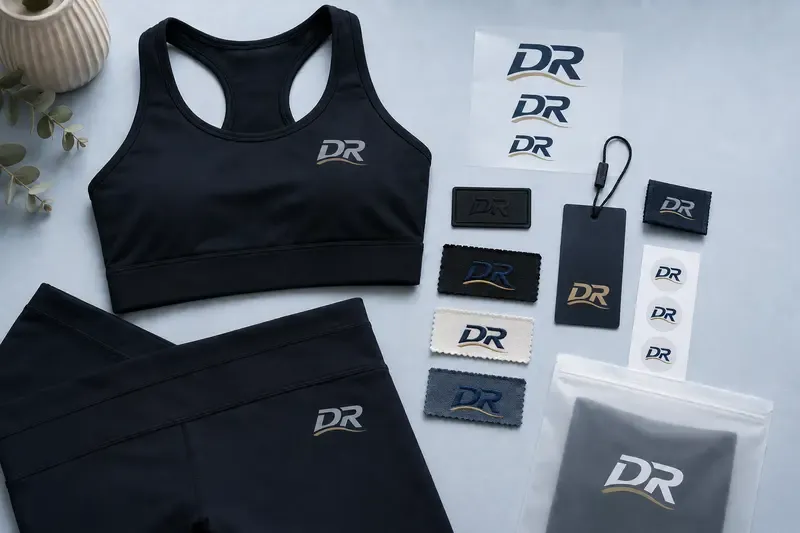
There is no single logo method that lasts longest on every gym garment, because the answer depends on your fabric, your logo size, and where the logo sits. A silicone logo is slightly raised, soft, and three-dimensional, and it suits a stretchy performance fabric because it moves with the fabric, as long as it is bonded well. A printed logo is flat and light, and it suits a large, simple design on a stable area of the garment. Embroidery is thread, so it suits a small, simple mark on a firmer fabric, and it struggles on very stretchy, thin fabric. The only way to know which one lasts on your garment is to test it: order one sample with your real logo, stretch it, wash it once in cold water, and check whether it lifts, cracks, or puckers. This article is for a new brand that is choosing a logo method for leggings, sports bras, or tops, and wants to decide before paying for a sample. It is not for a brand that has already chosen a method and only wants a bulk price, because the bulk price and the shipping price are both quoted for each order and are not fixed in this article.
What does each logo method look and feel like on gym wear?
Start with what your customer will see and touch, because the logo is the most visible part of your brand on the garment. A silicone logo sits slightly raised on the fabric and has a soft, three-dimensional feel. You can feel the edge of it with your fingertip, and it catches the light a little differently from the fabric around it, which is why brands that want a premium, tactile mark often choose it. It is made from a mould, and the mould costs 35 to 40 US dollars once for that logo, so the mould is a one-time cost, not a cost you pay again on every order. A printed logo is flat. It sits in the surface of the fabric, adds almost no weight, and feels like nothing at all when you run your hand over it, which suits a brand that wants the logo to be seen but not felt. A printed logo can carry fine detail and several colours, but every extra colour is another step in the work, so a simple one-colour or two-colour design prints more cleanly than a complicated one. Embroidery is thread stitched into the fabric, with a textured, raised feel that reads well on a chest or a sleeve where the fabric does not stretch much. None of the three is right or wrong on its own. Which one matches your garment is decided by the fabric, the size of the logo, and where the logo sits, not by which method looks best in a photograph.
Which logo survives stretch, sweat, and washing?
Gym wear is washed and stretched more than almost any other clothing, so durability is not about how the logo looks on the day it arrives. It is about how it looks after it has been worn, stretched, sweated in, and washed. Each method has its own weak point, and the sample test is where that weak point shows up. A silicone logo fails at the edges: if it is not bonded well, the edges lift when the fabric stretches under it, and a logo that lifts at the edges when you stretch the fabric will peel in wear. A printed logo fails by cracking: a print that is sharp when it arrives can crack when the fabric is stretched gently, and a crack on the sample will only grow in wear, so stretch it gently and look at the print under light. An embroidered logo fails by puckering and loose thread: the fabric underneath the stitching can pucker, so look at the fabric around the stitching as well as the stitching itself. Sweat and washing make all three harder, which is why the wash test matters: wash the sample once, by hand, in cold water, and let it air dry, then check the logo again. If it is unchanged after one wash, that is a good sign. If it lifts, cracks, or puckers, the sample has failed, and no bulk order should follow until the factory explains why and shows you a fixed sample.
Which method fits your fabric and your design?
The fabric decides more than the logo does. Our standard performance fabric is 78 percent nylon and 22 percent spandex at 230 grams per square metre, a blend that is smooth, stretchy in four directions, and matte rather than shiny, and a fabric that stretches in four directions is a hard place for a logo to live. On that kind of fabric, a silicone logo has an advantage, because the silicone is flexible and moves with the fabric instead of fighting it, as long as the bonding is good. A print can work on the same fabric, but only if the print is flexible enough to stretch with it, so ask the factory whether the print they use is made for stretch fabric, and prove it with the stretch test on the sample. Embroidery is the hardest of the three on a very stretchy, thin fabric, because the thread does not stretch the way the fabric does, so the stitching can pucker the fabric or feel stiff against the skin. Embroidery fits better on a firmer, more stable fabric, or on a part of the garment that does not stretch much, such as a chest panel or a hem. The size of the logo matters too. A small logo, a few centimetres across, is easier for every method, because there is less material to lift, crack, or pucker. A large logo, such as a wide mark across the back of a jacket, is harder for every method, and it is hardest for embroidery, because a large stitched area stiffens the fabric. Where the logo sits matters as much as its size: a logo on the centre of the chest or the middle of the back stretches every time the wearer moves, while a logo on a hem, a cuff, or the back of a neckband stretches far less. Before you choose, write down three things: your fabric, your logo size in centimetres, and the exact position of the logo, and send all three to the factory, because a factory that has those three facts can tell you whether your chosen method fits, while a factory that has only the logo file is guessing.
What does each method cost, and is there a minimum order?
Cost is where the three methods differ most, and the honest answer is that only one of them has a fixed price you can plan around. A silicone logo needs a mould, and the mould costs 35 to 40 US dollars once for that logo. Pay it once, and the same mould is used again on the next order, so the mould cost does not grow with your quantity. The price of the silicone logo itself, and the price of a printed or an embroidered logo, are quoted for each order, because they depend on the size of your logo, the number of colours, and the quantity, so this article does not fix a number for them. Ask for the logo price in writing for your exact logo, with its size, its colours, and its position, before you approve the sample, and compare the three methods on the same logo, not on three different designs. The minimum order is set by the order, not by the logo method: a fully custom order starts at 100 to 150 pieces per style per colour, and you can mix sizes within that quantity, while a ready-stock style with your logo added starts at 20 pieces per style per colour. A logo method does not change those minimums on its own, but it can change what you pay for the sample, because a sample costs 50 US dollars per piece, and a silicone sample also needs the 35 to 40 US dollar mould if your logo has not been made before. Sampling takes 10 to 15 days after your design and logo are confirmed, and bulk production takes 25 to 35 days after you approve the sample. Payment on the bulk order is a 30 percent deposit by bank transfer or PayPal, and shipping is quoted for each order, because the cost depends on the weight, the quantity, and where the goods are going.
How do you test a logo before you approve bulk?
Do not approve a bulk order on the strength of a photograph. A photograph cannot show you whether a logo lifts, cracks, or puckers, and the sample is the only place where those failures appear before they become a hundred faulty pieces. Order one sample of the style you will sell, in your size and your colour, with your real logo applied by the method you have chosen, in the size and the position you confirmed in writing. When it arrives, measure the logo with a ruler against what you confirmed, because a logo that is one centimetre off centre on a sample will be one centimetre off centre on a hundred pieces. Then stretch the fabric under the logo and look at the edges, the surface, and the fabric around it: a silicone logo should stay bonded and sit flat, a printed logo should stay sharp with no cracking, and an embroidered logo should be dense and even with no loose threads and no puckering underneath. Wear the sample for a full day if you can, and move in it the way your customer will, because a logo that survives a stretch test on a table can still fail when the garment is worn. Then wash it once, by hand, in cold water, and let it air dry, and check the logo again after it is dry. Write down what passed and what failed, with a photograph of each failure, and send that note to the factory in writing, because a factory can only fix what you name. If the logo fails, ask the factory to explain the cause and to make a corrected sample, and do not pay a bulk deposit until the corrected sample passes the same test. A second sample that fixes the problem is still cheaper than a bulk order that carries it.
Your next step: pick the method, then prove it with one sample
You do not need to decide the perfect logo method today. You need to decide the most likely one, and then prove it with a single sample. If your fabric is stretchy, your logo is small to medium, and you want a premium, tactile mark, start with silicone, and budget the 35 to 40 US dollar mould as a one-time cost. If your design is large and simple, and the logo sits on a stable part of the garment, start with print, and ask the factory in writing whether the print is made for stretch fabric. If your fabric is firm, your logo is small and simple, and you want a traditional, textured mark, start with embroidery, and check the fabric around the stitching for puckering on the sample. Whichever method you pick, send the factory your logo file, its size in centimetres, its exact position, your fabric, and your quantities per style per colour, and ask for the sample cost and the logo price in writing before you pay anything. A sample costs 50 US dollars per piece, sampling takes 10 to 15 days after your design and logo are confirmed, and bulk production takes 25 to 35 days after you approve the sample. To start, send us your logo file with its size and position, the style you want to sample, and the quantities you want per style per colour. We will confirm the sample cost, whether a 35 to 40 US dollar silicone mould is needed, and the sample date in writing before you pay anything, and we will reply within 1 business day.